Showing posts with label Education. Show all posts

Thursday, March 21, 2013

The Hakdanggol Revolutionary Site

The Hakdanggol Revolutionary Site is in the heart of Pyongyang, the capital of the Democratic People´s Republic of Korea. A monument is standing there with an inscription engraved against sculpture of the green pine tree.

Lecturer Ko Un Ha explained about the history of Hakdanggol.

"Hakdang Valley is a wide space between the Pyongyang Students and Children´s Palace, the Mansudae Assembly Hall, the Pothong Gate, the Mansudae Art Theatre and the Grand People´s Study House. In the past the place was called Hakdang or School or Hakdang-dong. Because there were many schools such as the Sungsil Secondary School and the Sungui Girls´ School, private schools and village schools."

The lecturer impressively explained about the historical facts a century ago. In the 1910s Korea was completely reduced to a colony of the Japanese imperialists. The outstanding leader of the anti-Japanese national liberation movement of Korea Kim Hyong Jik, father of the great leader Kim Il Sung, embarked on the road of revolutionary struggle to smash the armed enemy with the strength of the Korean nation, keeping the idea of "aim high" that national independence must be achieved through a struggle generation after generation. The lecturer said Kim Hyong Jik made efforts to bring up reliable pivots of a revolutionary organization to be formed in the future while studying at the Pyongyang Sungsil Secondary School in Hakdang Valley from the Spring of 1911.

The lecturer said.

"As his comrades increased one by one, Kim Hyong Jik became a professional revolutionary without finishing the course of the Sungsil Secondary School in order to expand the theatre of the revolutionary activities extensively. He conducted revolutionary activities at the Sunhwa School in Mangyongdae and Myongsin School in Ponghwa-ri using them as centres of his activities as a teacher favourable to the revolutionary activities and powerfully accelerated preparations to form a revolutionary organization in the future."

While listening to the lecturer, I saw in my mind´s eyes the Sunhwa School in Mangyongdae I visit every year. The bell of the Myongsin School in Ponghwa-ri rung by Kim Hyong Jik seemed to be sounding in my ears.

Kim Hyong Jik walked the untrodden path of history for national independence and people´s emancipation. Thanks to his strenuous efforts, the inaugural meeitng of the "Korean National Association" was held in Hakdang Valley on March 23, Juche 6 or 1917. Present there were core champions of independence movement, anti-Japanese movement champions at home and abroad and the patriotic youth and students.

The lecturer said the aim of the "Korean National Association" was to achieve national independence and build a true civilized state with the strength of the Koreans through their unity. The "Korean National Association" expanded its organizations to the wide areas at home and abroad less than half a year after its foundation and included people from all walks of life, soldiers of the Independence Army and even religionists.

Pointing to the inscription, the lecturer said:

"The inscription reads:
´Oh, his high aim for liberation
Shone on the silk-embroidered land of 3,000 ri,
Struck roots deep among the people
Breaking through forest of bayonets
Under the banner of anti-Japanese struggle,
Korea breathed with his intention
Even in far-off foreign land.´

Indeed, the ´Korean National Association´ formed by Kim Hyong Jik was a revolutionary organization for national independence to realize his idea of ´aim high´ and the first anti-Japanese underground revolutionary organization in Korea around the March First Popular Uprising."

The "Korean National Association" was recorded in the history of the Korean revolution.

I left the Hakdanggol Revolutionary Site, firmly believing that the idea of "aim high" of

Kim Hyong Jik is shining brighter thanks to respected Kim Jong Un.

Sunday, March 10, 2013

Historic Wangjaesan Meeting

Mt. Wangjae is in Onsong County, North Hamgyong Province in the northern border area of the Democratic People´s Republic of Korea.

The Wangjaesan Revolutionary Site is in the mountain. 80 years ago in March Juche 22 or 1933 the great leader President Kim Il Sung called a meeting of the heads of the underground revolutionary organizations and political operatives in the area of Onsong against the Japanese imperialists on Mt. Wangjae.

In those days the Japanese imperialists made desperate efforts to prevent the growth of the Anti-Japanese People´s Guerrilla Army and keep the revolutionary influence of the anti-Japanese armed struggle from reaching the people in the homeland.

IKE130128024_22


The Anti-Japanese People´s Guerrilla Army was faced with a task to further spread and develop the armed struggle deep into the homeland to promote the Korean revolution as a whole.

Deeply seeing through the prevailing situation and the demand of the developing revolution, President Kim Il Sung led a unit of the guerrilla army to the Onsong area.

The meeting of the heads of the underground revolutionary organizations and political operatives in the area of Onsong was held on Mt. Wangjae on March 11, Juche 22 or 1933.

At the meeting President Kim Il Sung delivered a historic speech under the title "To Spread and Develop the Armed Struggle into the Homeland".

Jang Hye Ryon, lecturer of the Korean Revolution Museum, has this to say:

"That day the great leader President Kim Il Sung made a specific analysis of the successes achieved after the founding of the Anti-Japanese People´s Guerrilla Army and the then situation of the revolution and put forward a strategic and tactical policy on spreading and developing the armed struggle into the homeland. His speech convinced the participants of the victory of the anti-Japanese revolution and gave them revolutionary zeal. They unanimously and actively supported the policies put forward by President Kim Il Sung and made a firm resolve to resolutely defend and implement them. Indeed, the Wangjaesan meeting was a significant meeting of historic importance in the development of the Korean revolution."

After the historic meeting, the general Korean revolution centred on the anti-Japanese armed struggle rapidly spread deep into the homeland. It was a historic occasion to make a new heyday of the Korean revolution.

Sunday, February 17, 2013

New Statues Erected at Mangyongdae Revolutionary School

Statues of the great Generalissimos Kim Il Sung and Kim Jong Il were erected at Mangyongdae Revolutionary School on the occasion of the birth anniversary of leader Kim Jong Il (the Day of the Shining Star). An unveiling ceremony was held with splendor on Saturday. The dear respected Marshal Kim Jong Un was present at the ceremony.

Also present there were Choe Yong Rim, Choe Ryong Hae, Jang Song Thaek, Hyon Yong Chol, Kim Kyok Sik, Kim Kyong Hui, Kim Ki Nam, Kim Yong Chun, Ri Yong Mu, O Kuk Ryol, Hyon Chol Hae, Kim Jong Gak, and officials of the party and armed forces organs, staff members and students of the school and its graduates, officials of units and military academies at all levels, service personnel of the KPA, military family members and officials and employees of the units who contributed to the erection of the statues and Pyongyangites.


Choe Yong Rim, Choe Ryong Hae, Jang Song Thaek and others unveiled the statues. Laid before them was a floral basket bearing the august name of Marshal Kim Jong Un. Laid there then were a floral basket in the joint name of the Central Committee and the Central Military Commission of the Workers' Party of Korea and the National Defence Commission of the DPRK and a floral basket in the name of the school.

Floral baskets were also placed in the name of the General Political Bureau of the KPA, the General Staff of the KPA, the Ministry of the People's Armed Forces and units and sub-units of the KPA at all levels and military academies.

All the participants paid tribute to the Generalissimos in humblest reverence. KPA Vice Marshal Choe Ryong Hae, member of the Presidium of the Political Bureau of the Central Committee of the WPK and director of the General Political Bureau of the KPA, made a speech there.

He went on:

Kim Jong Il deemed it as an important work for giving steady continuity to the bloodline of revolution to educate the children of revolutionary martyrs from the first day of his revolutionary leadership and paid deep attention to the work of the school in the grim days of leading to victory the confrontation with the U.S. and the struggle for defending socialism under the uplifted banner of Songun.

It was the unanimous desire of all teachers and pupils of the school and service personnel of the KPA to erect the statue of Kim Jong Il at the school where people erected Kim Il Sung's statue for the first time in Korea at the initiative of anti-Japanese war hero Kim Jong Suk who took into consideration the ardent desire of the schoolers to see Kim Il Sung every day.

The ardent desire of the teachers and pupils and all service personnel has become a brilliant reality thanks to the intense loyalty and meticulous guidance of Marshal Kim Jong Un.

Rosy is the future of the children of revolutionary martyrs, the speaker said, calling for waging a dynamic struggle to reunify the country and accomplish the Juche-based revolutionary cause of Songun under the leadership of Kim Jong Un, the banner of eternal victory of the great Paektusan nation, as befitting the descendants of Generalissimo Kim Il Sung and the soldiers and disciples of Generalissimo Kim Jong Il.

Kim Jong Un warmly acknowledged the cheers of all the participants. -0-


Friday, February 1, 2013

Vol. 3 of "Complete Collection of Kim Jong Il's Works" Off Press

 Vol. 3 of "Complete Collection of Kim Jong Il's Works" Off PressVol. 3 of "Complete Collection of Kim Jong Il's Works" was published in the DPRK. It deals with his works in chronological order. It contains 108 works such as speeches and talks between May and December Juche 50 (1961). Among the works are "Let Us Glorify the Cause of Our Party Forever" and "On Effectively Guiding Party Life of Party Members in Conformity with Duty of Party Cell".
These works clarify the principled issues to be held fast to in glorifying the cause of the party and developing it into a revolutionary and militant party. The book includes "Youth and Students Are Masters Responsible for Future of Science and Technology in Our Country" and "Let Us Learn from Revolutionary Habit of Study of Anti-Japanese Revolutionary Fighters".

Those works clarify tasks and ways to bring about a radical change in the study of the students. There are also in the book "On Solving the Theoretical Issue of Political Economy on the Basis of Our Party's Policy" and "On Some Experiences in Socialist Economic Construction in Our Country".

These works deal with the issue of thoroughly establishing Juche in scientific researches and successes and experiences gained in socialist construction under the leadership of the Party. There are such works as those clarifying ways to implement the economic policy of the Party. Among them are "On Giving Full Play to Advantages of Socialist Planned Economy" and "7-year Plan Is Economic Construction Programme for Stepping Up Socialist Construction".

The book contains such works as those dealing with tasks facing the youth and students and service members to play the role of a shock brigade in the efforts to realize the far-reaching plan of President Kim Il Sung to build Pyongyang into a more magnificent and beautiful city and with the issues of popularizing sports and making it part of one's life to practice sports. It also contains works which give answers to theoretical and practical issues arising in various fields.

Friday, January 18, 2013

Metallurgical History of Korea

[nggallery id=117]Among the excellent scientific and technological heritage of Korea is its metallurgical technology with a long history. The bronze metallurgy was applied on a high level in the latter half of the fourth millennium BC. Bronzeworks were multifarious. Weaponry and implements included axe, dagger, arrowhead and chisel and ornaments included ring, bell, bracelet, earring and button.


Since the founding of Ancient Joson, the bronze metallurgy was further developed. In those days the Korean ancestors developed the method of minutely regulating the alloy ration according to their uses and applied it to practice while inheriting the previous alloyage of three elements (copper, tin and lead).


As the people in Ancient Joson began to mass-produce iron from the end of the second millennium BC, they directed their efforts to the development of iron and steel production and metal processing skill to produce weapons, tools, harness and other ironware.


Typical relics are iron pieces and slags unearthed at dwelling site No. 2 in the Koyon-ri site in Hwangju County, North Hwanghae Province, a pig-iron axe in the first half of the first millennium BC in the Pomuigusok site in Musan County, North Hamgyong Province, and a steel axe in the latter half of the first millennium BC in the Ronam-ri site in Sijung County, Jagang Province.


Following the ancient states, the Three Kingdoms (the 3rd century BC-the 7th century AD) refined further the metallurgy.


The metallurgy in the period of Koguryo (277 BC-AD 668), in particular, reached a high level. Quality steel and cast-iron weapons, tools and farm implements were made in great numbers from the outset of its founding. Many of them were unearthed in the Ronam-ri site in Sijung County, Jagang Province, and other sites.


Diverse kinds of daily household iron goods included pot, brazier and nail. An iron brazier discovered in tomb No. 1 in Ryongho-ri, Unsan County, North Phyongan Province, and an iron tripod pot with handles discovered around Pyongyang are well known as delicate castings.


Especially, an armor coated with iron scales found along the Amnok River basin is one of the typical relics that show the high level of steel casting and forging of Koguryo.


Many of quality iron products of Koguryo were exported to neighbouring countries.


The skill of refining gold, silver and copper developed to a high degree.


A historical record wrote that “hundreds of houses settled down at a silver mine to dig silver for national use”. This is a glimpse into the then mining scale of Koguryo. The people of Koguryo wrought articles in gold, silver and copper by refining ores and applying the casting, rolling, gilding, alloying and chasing to the primarily processed gold, silver and copper.


In the period of Koryo mining and metallurgical techniques made good progress. According to historical records, iron was made in 67 districts across the country from the late period of Koryo to the early period of the feudal Joson dynasty. Iron was made from iron sand abundant at riversides in 20 districts and from iron ore in the other districts.


At that time a rapid progress was also made in the copper refining to produce a great deal of copper. In 959, brass was exported to a neighbouring country.


The prospecting for minerals was pushed ahead and the iron and steel making and refining were activated in the period of the feudal Joson dynasty. In 1428 the output of the five ironworks in the Chungchong provincial area amounted to over 60 tons. It was at a high level, taking account of the proportion of its population. New technique was applied to silver refining to increase silver production. The actual extract rate was not so high before. It was raised three times by the introduction of new additives.


Like this, Korean ancestors’ metallurgy with a long history and tradition made a great contribution to strengthening the national power and developing science and technology of mankind.

Monday, September 24, 2012

Joint Scientific Conference of Kim Il Sung University and Eurasia-Pacific Uninet Opens

[nggallery id=43]

Joint scientific conference of Kim Il Sung University and the Eurasia-Pacific Uninet opened with due ceremony at Kim Il Sung University Monday. The conference whose theme is "Biomedical and Biotechnological Progress for a Healthy Society" will be held, divided into life science panel and veterinary science panel and scores of papers will be presented to it.

Present at the opening ceremony were teachers and researchers of the university and prominent scholars who are members of the delegation of the Eurasia-Pacific Uninet led by Vice-Chairman Wolf-Dieter Rausch.

An opening speech and congratulatory speeches were made there.

Kim Kyun, first vice-president of Kim Il Sung University, expressed the conviction that the conference would offer an important occasion for deepening friendship and bonds between the two universities and opening a new chapter for exchange and cooperation between them.

Song Ja Rip, president of Kim Il Sung University and minister of Higher Education, said that the conference of renowned scholars is of great significance, voicing conviction that the conference would actively contribute to the promotion of well-fare and health of the people in the DPRK and various other countries.

Wolf-Dieter Rausch said that the delegation deems it an honor to organize the conference jointly withKim Il SungUniversity.

Buyantogtokh Choijilsuren, doctor of the National University of Mongolia, said that it was pleasure for her to take part in the conference, wishing it bigger success.

Panel discussions were held.

The Eurasia-Pacific Uninet hosted a reception at the Taedonggang Diplomatic Corps Club for the participants in the conference on the same day.

Monday, September 3, 2012

Kim Jong Il′s Pledge Made on Ryongnam Hill

[nggallery id=31]It was on September 1, Juche 49 (1960) that leader Kim Jong Il began studying at Kim Il Sung University. On the day, he recited a poem "Korea, I Will Glorify Thee" on Ryongnam Hill on the campus of the university, out of mind to glorify the country. At that time Kim Jong Il said that the poem reflected his long-cherished feelings. The poem was as good as a solemn oath he took before the country and the people. In order to carry it into practice, he studied hard at the university. He conducted energetic ideo-theoretical activities to clarify the position and role of the leader and prove the uniqueness of President Kim Il Sung's revolutionary ideas.

During his military camping in Oun-dong, Pyongyang, in his university days, he systematized and developed the Juche-based military idea, theory and tactics, laying solid ideo-theoretical foundation for the Songun (military-first) politics.

For scores of years since the historic day,Kim Jong Il wisely led the work for carrying forward the revolutionary cause of Juche, thus performing great feats for the country and the people.

He developed in depth and an all-round way the immortal Juche idea, founded by the President, making it the guiding idea in the era of independence.

He flawlessly proved the validity, scientific accuracy and truth of socialism as well as inevitability of its victory, thus providing a sure guarantee for the progress of the world socialist movement and the triumphant advance of the cause of independence against imperialism.

In the days of his guidance over the Songun revolution, he devoted all his mental and physical energies to turning the DPRK into an ideological and political and military power.

His oath has been carried forward by

Kim Jong Un, supreme leader of the Workers' Party of Korea and the DPRK.

Saturday, September 1, 2012

Kim Jong Un Looks Around the E-Library at KPA Exhibition of Arms and Equipment

[nggallery id=27]Supreme Commander of the Korean People's Army (KPA) Kim Jong Un, first secretary of the Workers' Party of Korea and first chairman of the DPRK National Defence Commission, looked round the newly built e-library at the Exhibition of Arms and Equipment of the KPA.

He went round various rooms of the e-library to learn in detail about its construction and operation.

The design of the library is good and the best quality is ensured in its construction and, at the same time, all facilities have been provided to meet the need of science and technology, he said, expressing satisfaction over the successful construction of a modern e-library as required by the age of knowledge-based economy.

He noted that the e-library is another grand edifice in the era of Songun demonstrating the might of intellectual potential of the DPRK as it has all conditions for study and research into the latest military science on the basis of huge data base and system of cutting-edge IT.

While seeing e-books, newspapers, magazines and other books on display, he said that a lot of people would visit this place.

The exhibition and e-library are the places urgently necessary for fully equipping service persons with Korean-style unique strategy and tactics and significantly stepping up the military and technical preparations of the KPA as required by the characteristics of modern warfare and the tense situation, he added.

Underlining the need to build more edifices in the era of Songun meeting the aesthetic taste and requirements of the Korean people, he noted that to this end it is necessary to study and create new, unique and peculiar architectural styles and ensure formative art in construction.

He made the rounds of various halls and outdoor display ground of the exhibition.

He looked round with keen interest the exhibits one by one, recollecting the great Generalissimos who gave top priority to the development of defence industry for arming the KPA with modern weapons and combat and technical equipment, regarding the work to bolster up military capability as an important matter of protecting the destiny of the country and the nation and socialism.

He gave instructions to continue directing primary efforts to the development of defence industry, true to the party's idea of attaching importance to military affairs so as to produce more ultra-modern arms and equipment capable of overpowering any enemies and steadily raising the level of modernization of weapons and combat and technical equipment of the KPA.

He mounted the newly built observation deck to command a bird's-eye view of the exhibition and set forth important tasks to be fulfilled to manage and operate it.

He was accompanied by Choe Ryong Hae, Jang Song Thaek, Kim Ki Nam, Choe Thae Bok, Kim Yong Il, Kim Yang Gon, Kim Phyong Hae, Mun Kyong Dok, Paek Se Bong, Han Kwang Sang, Han Kwang Bok, Pak Thae Song, Kim Pyong Ho and Ma Won Chun.

Monday, August 27, 2012

Youth Delegates Tour Various Parts of Pyongyang

[imagebrowser id=21]Delegates to the celebrations of Youth Day visited various places of Pyongyang. They went to the Exhibition of Arms and Equipment of the Korean People's Army. Being briefed on the fact that the exhibition was successfully built under the leadership of the dear respected Kim Jong Un, they looked round small arms, various types of artillery pieces, tanks, armored cars, warships, aircraft, strategic rockets and other combat and technical equipment manufactured at munitions factories in the DPRK.

They visited the Victorious Fatherland Liberation War Memorial Tower. Lecturers of the Tower warmly welcomed them with bunches of flowers, They laid a floral basket and bunches of flowers before the main sculpture "Victory". They also went to the Three-Revolution Exhibition. At the Hall of Works on the Juche Idea they grasped ideological and theoretical feats of President Kim Il Sung and leader Kim Jong Il. They moved to the Hall of Heavy Industry and the National House of Class Education.

A Meeting Celebrating Youth Day Held with Splendor

[imagebrowser id=17]A meeting celebrating Youth Day took place with splendor in Pyongyang on Monday to accomplish the revolutionary cause of Juche under the leadership of the dear respected Marshal Kim Jong Un.

Kim Jong Un has taken measures to celebrate the first Youth Day in the new century of Juche with splendor as a great event of the whole country.

Present there were Choe Yong Rim, Choe Ryong Hae, Hyon Yong Chol, Kim Kyong Hui and other senior officials of the party, the state and the army, delegates to celebrations of Youth Day, officials of the youth league, officials concerned, youth and students in the city, a delegation of Korean youth and students in Japan and a delegation of the Confederation of Korean Youth in China.

Present there on invitation were officials of party and armed forces organs, working people's organizations, ministries and national institutions.

A congratulatory message sent by Kim Jong Un, first secretary of the Workers' Party of Korea, to the participants in the celebrations and young people across the country from the way-off front was read out at the meeting.

Upon receiving the message sent by him, all participants broke into enthusiastic cheers of "hurrah!"
Officer Kim Hyon Hyok, who took the floor on behalf of the soldiers of the Korean People's Army, said that the message sent by Kim Jong Un serves as a banner of victory as it encourages young people to perform new feats in the defense of the country and the great drive to build a thriving nation.

The Supreme Commander has ushered in a new heyday in developing the revolutionary armed forces with his rare military wisdom, outstanding commanding arts, iron-willed pluck and noble love for comrades-in-arms, he noted, adding:
We soldiers will become a scout party in the great war for the country's reunification advancing, leveling rifles at one target as indicated by Kim Jong Un, and indomitable fighters and young heroes dashing ahead towards enemy positions, shouting "Long Live Marshal Kim Jong Un!"

If the enemies fire even a single shell on the inviolable territorial waters and territory of the country, we will never miss the golden opportunity but reduce at one go all the places where they are entrenched to ashes with deadly retaliatory blows.

Labor Hero Ju Myong Gil, a worker of the Hungnam Fertilizer Complex who spoke on behalf of the young workers, said that they would courageously advance toward a final victory in the drive to build a thriving nation, loudly sounding the grand march of the youth, in hearty response to the militant tasks set forth in the message.

All workers will keep themselves highly alerted, each tightly holding a rifle in one hand and a hammer in the other, and dynamically wage a charge for increased production, he declared, adding: If the enemies dare fire even a single shell at this land, we will form young workers units and turn out in all-people resistance.

Ri Un Jong, a tractor driver of the Poman Co-op Farm of Sohung County who took the floor on behalf of young farmers, said that young people in agricultural field would successfully do farming with transparent loyalty and patriotic enthusiasm, fully armed with Kim Jong Il's patriotism and thus do their bits in increasing the nation's grain production.

When the moment to launch a decisive battle comes, we will wage a sacred war for crushing the enemies, standing alongside the fighters of the KPA in the same trenches for defending the country, and conduct a dynamic struggle for increased wartime grain production and send greater quantities of food to the front, she declared.

Kim Chung Il, student of Kim Il Sung University who spoke on behalf of students, said: All students will thoroughly arm themselves with the idea of the party true to the noble intention of Kim Jong Un and study hard for the sake of the country and thus grow to be able builders of a thriving socialist nation and proud revolutionary talents.

If the U.S. imperialists and the Lee Myung Bak group of traitors dare ignite a war against the inviolable land of the country, we will replace pens by arms and courageously rush to the front to mercilessly wipe out the enemies and certainly achieve the historic cause of the country's reunification, he stated.

Thursday, August 23, 2012

Performance Given by Members of Art Group of Mangyongdae Schoolchildren′s Palace

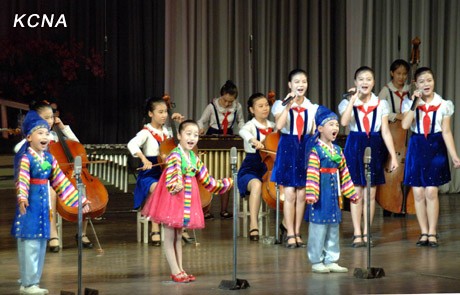
A performance was given by members of the art group of the Mangyongdae Schoolchildren's Palace on Thursday to mark the 52nd anniversary of leader Kim Jong Il's start of Songun revolutionary leadership. It began with prelude "May Generalissimo's Star Shine Forever". Put on the stage were female chorus "Light of Jeep" and other colorful numbers.

The performers impressively represented the boundless reverence for Kim Jong Il who devoted all his life to the prosperity of the country and the happiness of posterity till the last moments of his life since he started the Songun revolutionary leadership.

Also staged were numbers dealing with the joy of happy children under the care of the dear respected

Kim Jong Un and reflecting the will of the children to fight in defense of the country under his leadership just as the juvenile guerrillas did during the war when the time to wage a decisive battle comes.

Wednesday, August 22, 2012

Photo Exhibition Opens on Youth Day

[slideshow id=4]

A photo exhibition "Youth, Forward Following Great Party!" was opened in Pyongyang to mark Youth Day.

Displayed at the exhibition hall are a photo of President Kim Il Sung and leader Kim Jong Il standing on Mt. Paektu.

Also display are more than 60 photos showing the leadership exploits and noble traits of the peerlessly great men of Mt. Paektu who put forward the youth as the flowers of the country and the nation and the most viable unit of society.

On display there are at least 120 photos of young people giving full play to their resourcefulness and valor at each construction site for a great surge.

"The great leader Comrade Kim Il Sung guides a meeting of the young communist league" and other photos help visitors to recollect the revolutionary history of Kim Il Sung who conducted energetic activities for the strengthening and development of the Korean youth movement.

"The great leader Comrade Kim Jong Il hands over torchlight of revolution to young people", "The great leader Comrade Kim Jong Il awards the flag of the Kim Il Sung Socialist Youth League" and other photos deal with the undying feats of Kim Jong Il who brought up youth to be reliable successors of the Juche cause.

"The dear respected Marshal Kim Jong Un, supreme leader of our party and people" and other photos show well the noble traits of Kim Jong Un who is recording the epic of great loving care with his noble outlook on the rising generation and the future.

The opening ceremony of the photo exhibition took place on Wednesday.

Present there were Ri Yong Su, department director of the C.C., the Workers' Party of Korea, officials concerned, officials of the youth league and youth and students in Pyongyang.

Tuesday, August 21, 2012

International Academic Symposium Opened

[imagebrowser id=2]

Pyongyang, August 21 (KCNA) -- The international academic symposium of Kim Il SungUniversity was opened with due ceremony at the university Tuesday. The symposium on the theme of "For social progress and prosperity" will hear more than a hundred valuable academic papers. Present there were Vice Premier Kim Yong Jin, Chairman of the Education Commission Kim Sung Du and officials, teachers and researchers of the university.

Also present were Prof. and Dr. Elmar Kulke, dean of a faculty who is a delegate of Humboldt University of Germany, a delegation of Muenster College of Applied Sciences of Germany led by Head of a department Martin Weischer, a delegation of Chinese Ministry of Education led by Director Liu Baoli, a delegation of Liaoning University of China led by Prof. and Dr. Huang Taiyan, president of the university, a delegation of Yanbian University of China led by Rector Pak Yong Ho, a delegation of Jilin University of China led by Prof. Han Xiping, director of Marxist School, a delegation of the People's University of China led by Prof. Niu Weilin, permanent deputy secretary of the university party committee, Associate Prof. Chen Weipeng, delegate of Qinghua University of China, Prof. Pak Kon Il, delegate of the Academy of Social Sciences of China, Marceli Burdelski, delegate of Gdansk University and vice-president of the International Science Association of Poland, and Kim Jong, delegate of Joson University of the General Association of Korean Residents in Japan..

Present there on invitation were staff members of foreign embassies here.

There was an opening address and congratulatory speech at the opening ceremony.

Song Ja Rip, president ofKim Il SungUniversity and minister of Higher Education, said that the academic symposium will offer an opportunity to have a brisk exchange of successes and experience gained by teachers and scientists ofKim Il SungUniversity and foreign universities and scientific research institutions and widely exchange their views.

He expressed belief that the symposium will be an occasion to strengthen friendship bonds between themselves and boost exchange and cooperation.

Vice Premier of the Cabinet Kim Yong Jin noted that it is natural for educators and scientists to take the lead of social progress and promote prosperity.

He said the DPRK government has paid great attention to rapidly developing education and science and technology as required by the world trend.

The floor was taken by the heads of the delegations of the Chinese Ministry of Education and Yanbian University of China and the delegate of University of Gdansk of Poland. They congratulated the opening of the symposium saying that they were honored to take part in the symposium.

They expressed the conviction that the participants would make positive contribution to the work for social progress and prosperity through the symposium.

The participants looked round the photos showing the history of

Kim Il SungUniversity which developed into the supreme temple of Juche-oriented education and science.

Participants of Int′l Academic Symposium Pay Homage to Kim Il Sung and Kim Jong Il

Pyongyang, August 21 (KCNA) -- The participants of the international academic symposium of Kim Il Sung University laid a floral basket and bunches of flowers before the statues of President Kim Il Sungand leader Kim Jong Il on Mansu Hill Tuesday before paying tribute to them. On the same day the chairman of the Italian General Investment Group placed a floral basket before the statues.

Monday, August 20, 2012

Selected Works of Kim Jong Il (Enlarged Edition) Vol. 17 Published

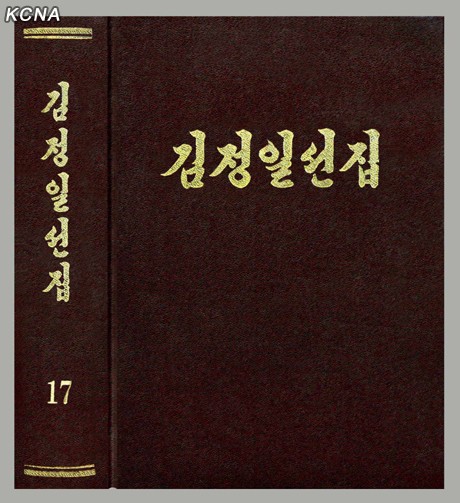
Volume 17 of Selected Works of Kim Jong Il (enlarged edition) was brought out by the Workers' Party of Korea Publishing House. The book contains 26 works including speeches, papers and talks published by leader Kim Jong Il from May 1992 to May 1994.

In the works "On the Fundamentals of Revolutionary Party Building" and "Let Us More Firmly Strengthen Socialist Revolutionary Position by Doing Party Work Well" he indicated unique ideas, theories and policies for strengthening the WPK into the revolutionary party of Juche type and enhancing its leadership role.

Such works as "Let's Give Fuller Play to the Advantages of Our People's Power" and "On Some Problems Arising in the Party, State and Economic Work" clarify the solid nature, vitality, function and role of the people's power, the basic principle for building the people's power and issues arising in strengthening the work of people's power bodies.

In the work "On Declaring State of Semi-War for Whole Country, People and Army" he laid down a revolutionary policy for frustrating the joint military exercises Team Spirit 93 of the U.S. imperialists and south Korean puppet regime for aggression and protecting the security of the DPRK and its people.

There are works which give clear answers to theoretical and practical issues concerning socialist economic construction, the matters related to the tasks facing the officials in revolution and construction and clarify the basic mission and essential character of the Korean youth movement.

There are also works indicating tasks and ways for building socialist national culture and giving full play to the advantages of healthcare system in the DPRK.

The book also deals with the ideas, theories and policies for stepping up the modernization of post and tele-communication and improving city management and forestry as required by the developing situation.